
How UV-C Germicidal Lamps Work: The Science of 254nm Disinfection
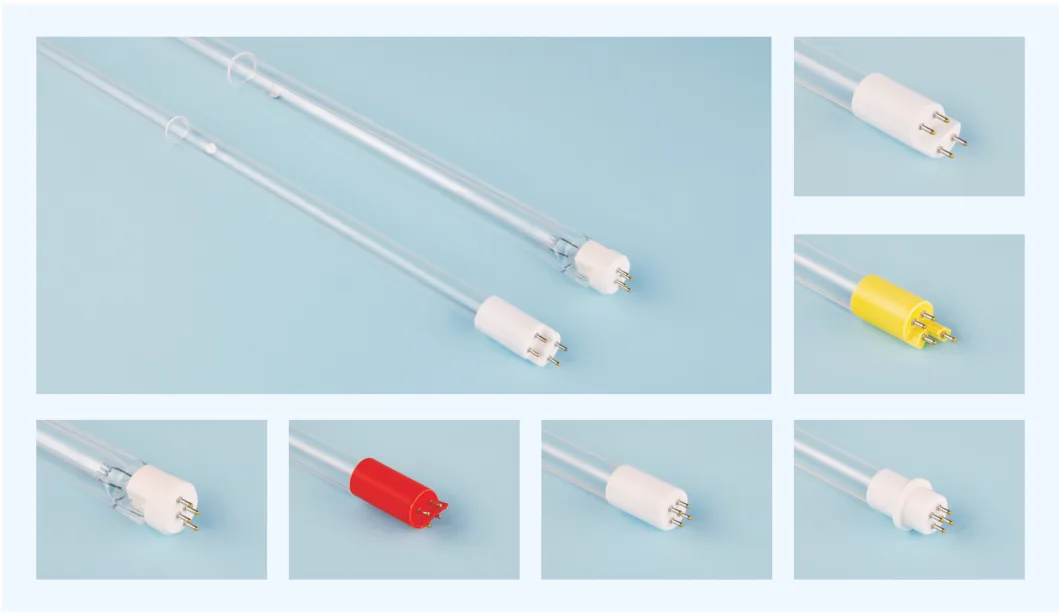
Ultraviolet germicidal irradiation has been disinfecting municipal water, hospital air, and laboratory surfaces for over a century — and it remains the only major disinfection technology that adds nothing to the medium it treats: no chemicals, no taste, no residue, no resistance development. At the heart of every UV disinfection system is a deceptively simple component: the low-pressure mercury germicidal lamp, engineered to pour its energy into a single wavelength, 254 nanometers.
This article explains exactly how that wavelength stops microorganisms from reproducing, why lamp engineering matters more than raw wattage, how to think about UV dose, and where each lamp format fits — from a 4-watt compact tube inside a home appliance to a 500-watt amalgam lamp treating municipal water.
What Makes 254nm Special
Ultraviolet light spans 100–400nm, but germicidal power is concentrated in the UV-C band (100–280nm). Microbial DNA and RNA absorb UV most strongly around 260–270nm, with the peak near 265nm. Low-pressure mercury vapor lamps happen to emit approximately 90% of their UV output at 254nm — within 4% of that biological peak. This near-perfect coincidence of lamp physics and microbiology is why 254nm became the global standard wavelength for germicidal equipment.
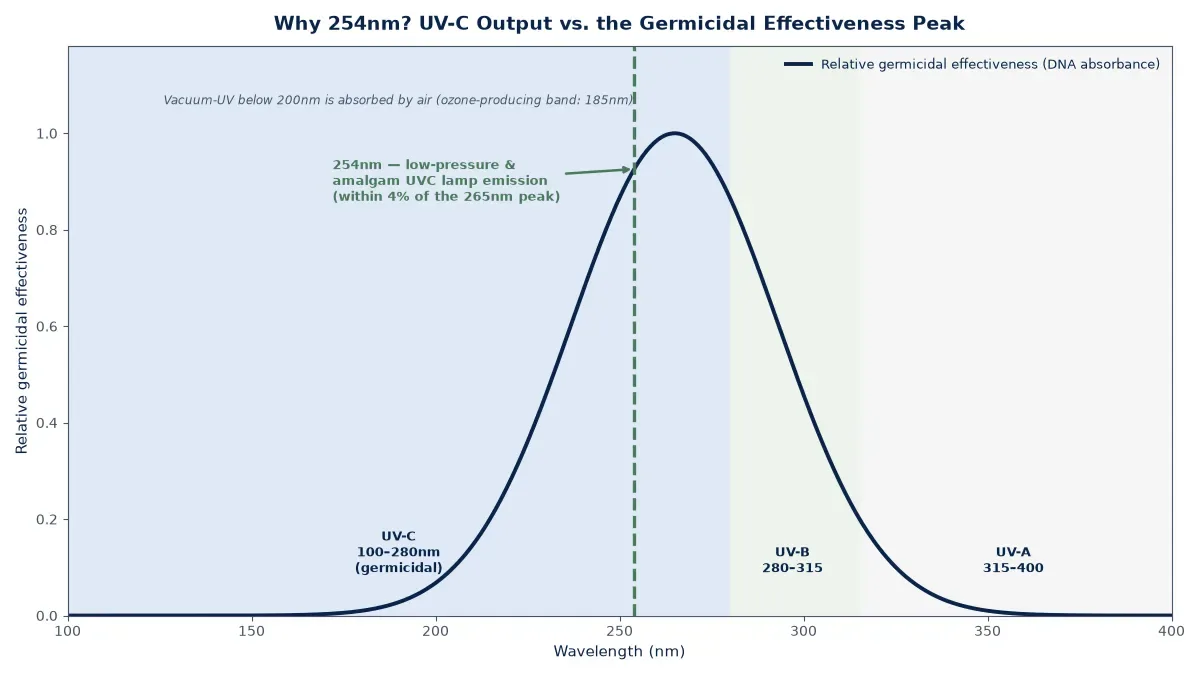
Some lamps also emit at 185nm (vacuum-UV), which is absorbed by oxygen in air and generates ozone — useful when ozone fumigation is wanted, and filtered out by ozone-free quartz formulations when it is not. Our UV + ozone + heat cabinet article covers how that pairing works inside disinfection cabinets.
The Inactivation Mechanism: Thymine Dimers
When a UV-C photon is absorbed by microbial DNA, it delivers enough energy to trigger a photochemical reaction between adjacent pyrimidine bases — most notably fusing two neighboring thymine molecules into a thymine dimer. Each dimer is a kink in the genetic code. During replication, the cellular machinery stalls at these lesions; the organism cannot divide.
This is the key insight behind UV disinfection: it does not need to kill the cell outright. A bacterium or virus that cannot replicate cannot cause infection, cannot form a colony, and cannot multiply downstream. Microbiology calls this inactivation, and it is measured in log reductions — a 99.9% (3-log) inactivation means one organism in a thousand remains replication-capable.
The required UV dose varies by organism. Most common bacteria and viruses are inactivated at 10–40 mJ/cm²; hardy spores and some molds demand significantly more, which is why system designers size for the toughest expected target, not the average one.
Dose = Intensity × Time: The Engineering Equation
UV disinfection obeys a simple law:
UV dose (mJ/cm²) = irradiance at the target (mW/cm²) × exposure time (s)
Every design decision flows from this equation:
- Distance matters. Irradiance falls off with distance from the lamp, so chamber geometry, reflective surfaces, and lamp placement are as important as lamp power.
- Flow rate matters. In water and air systems, dose is delivered on the fly; faster flow means less time under the lamp, which must be compensated with higher-output lamps or more of them.
- Lamp aging matters. A quality low-pressure lamp retains ≥80–90% of its initial UV output at end of rated life; cheap lamps decay far faster and silently under-dose.
- Fouling matters. In water systems, the quartz sleeve separating lamp from water must stay optically clean, or delivered dose collapses.
Lamp Formats and Where Each Fits
“UV lamp” is a family, not a product. The major engineering branches:
| Format | Typical power | Strengths | Typical use |
|---|---|---|---|
| Single-ended straight (4-pin) | 4–79W | Compact, one-end wiring, easy retrofit | Water purifiers, cabinets, small air units |
| Double-end straight T5 | 4–79W | Slim, symmetric, high volume | Ducts, conveyor tunnels, OEM equipment |
| H-shape / compact PL | 5–36W | High output per length, tiny footprint | Appliances, room sterilizers, aquariums |
| High-output (HO) 800mA | 38–180W | ~2× output of standard lamps per length | Commercial air handlers, larger water skids |
| Amalgam | 42–500W | Stable output over wide temperature range, 13,000h life | Municipal water, industrial process water |
Amalgam lamps deserve special mention. Standard low-pressure lamps lose output when the lamp wall runs too hot or too cold, because mercury vapor pressure drifts from its optimum. Amalgam technology binds the mercury in a solid alloy that buffers vapor pressure across a wide operating window — holding ≥90% output from roughly 4°C to 40°C ambient and at high power loadings. For industrial water treatment and HVAC duty where conditions swing, amalgam is the professional default, with rated lives of 9,000–13,000 hours (roughly 12–18 months of continuous operation) before output drops to replacement threshold.
Application Scenarios
Water treatment — From under-sink purifiers to municipal plants: lamps in quartz sleeves inside flow-through reactors. UV handles chlorine-resistant pathogens (notably Cryptosporidium and Giardia) without altering taste or creating disinfection byproducts.
Air and HVAC — Upper-room germicidal fixtures, in-duct arrays, and coil-irradiation systems that keep cooling coils biofilm-free while disinfecting recirculated air. HO and amalgam lamps dominate here for their output density.
Surface and equipment — Disinfection cabinets, conveyor tunnels, packaging lines, and cleanroom pass-throughs. Sealed enclosures make interlocking straightforward — UV-C demands respect for eyes and skin, so every professional design is either enclosed or occupancy-controlled.
OEM integration — Appliance makers embed compact single-ended and H-shape lamps in water dispensers, refrigerators, washing machines, and air purifiers. Lamp selection at this level is an engineering conversation about dose, space, ballast, and lifetime — exactly the conversation our lamp series pages are built to start.
Featured Series: Amalgam UVC Lamps, 42–500W
If your application involves water, moving air, or temperature variation, start with our Amalgam UVC Germicidal Lamp series: 25 models across T5/T6/T10 envelopes from 42 to 500 watts, 13,000-hour rated life, and the stable output curve that continuous-duty systems depend on. For compact and cost-sensitive integrations, the same catalog covers single-ended, double-end T5, high-output, and H-shape compact formats — every one manufactured to consistent UV-output specifications with full OEM support.
Tell our engineers your target organism, flow rate or chamber volume, and available space — we will return a lamp and dose configuration matched to your process.