
UV + Ozone + Heat Disinfection Cabinets: How Triple-Action Sterilization Works
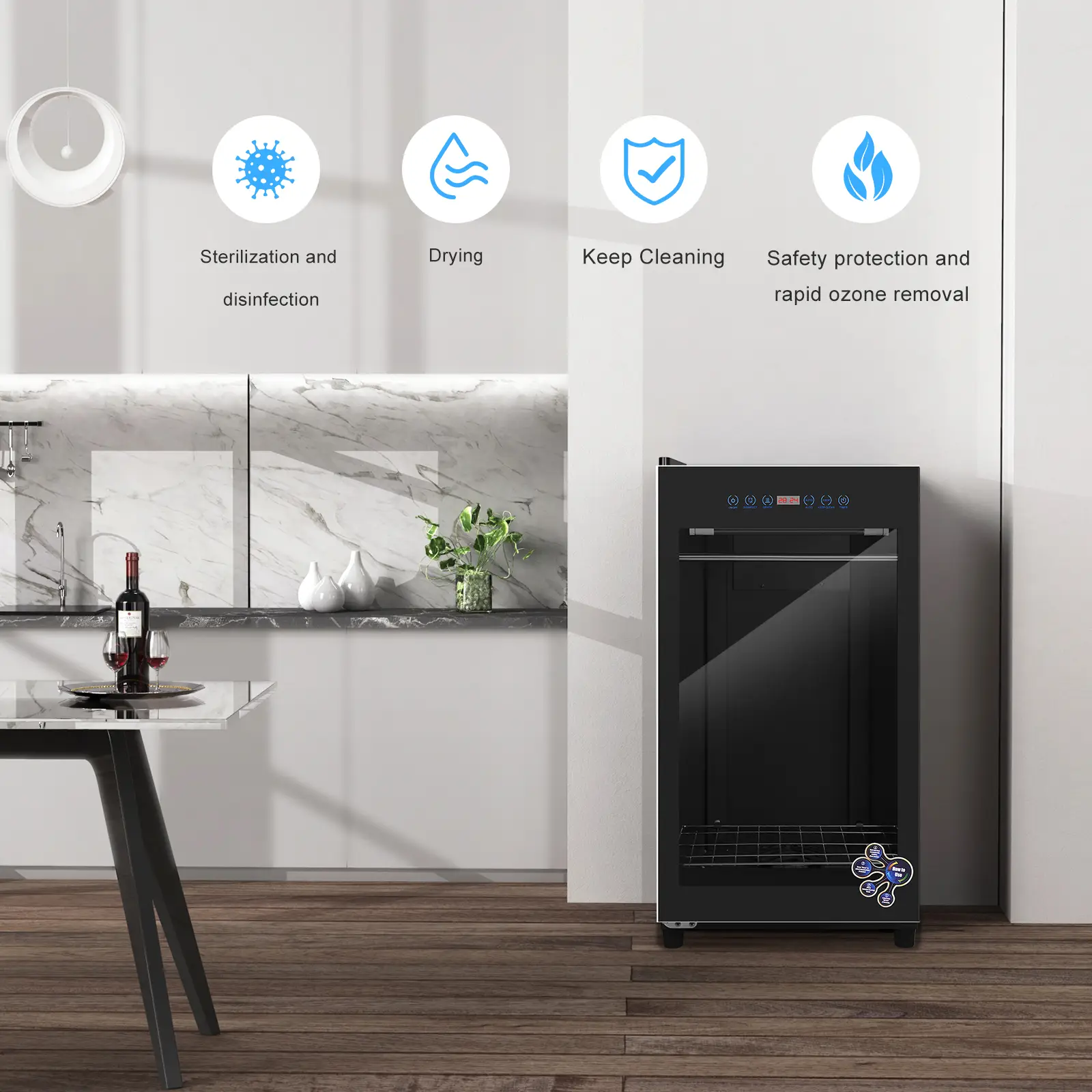
Walk into a dental clinic, a beauty salon, a hotel laundry room, or a well-equipped modern kitchen, and you will find the same quiet workhorse: a disinfection cabinet running a UV + ozone + heat cycle on the items people trust to be clean. These triple-action cabinets have become the default choice wherever chemical disinfectants are impractical — no liquids, no residues, no manual wiping, just a sealed chamber and a validated process.
But what actually happens inside that chamber? Why do manufacturers combine three separate sterilization mechanisms instead of relying on one? And how do you match a cabinet to your workload? This article breaks down the science, the coverage logic, and the real-world applications of UV + ozone + heat disinfection cabinets.
How Each Sterilization Mechanism Works
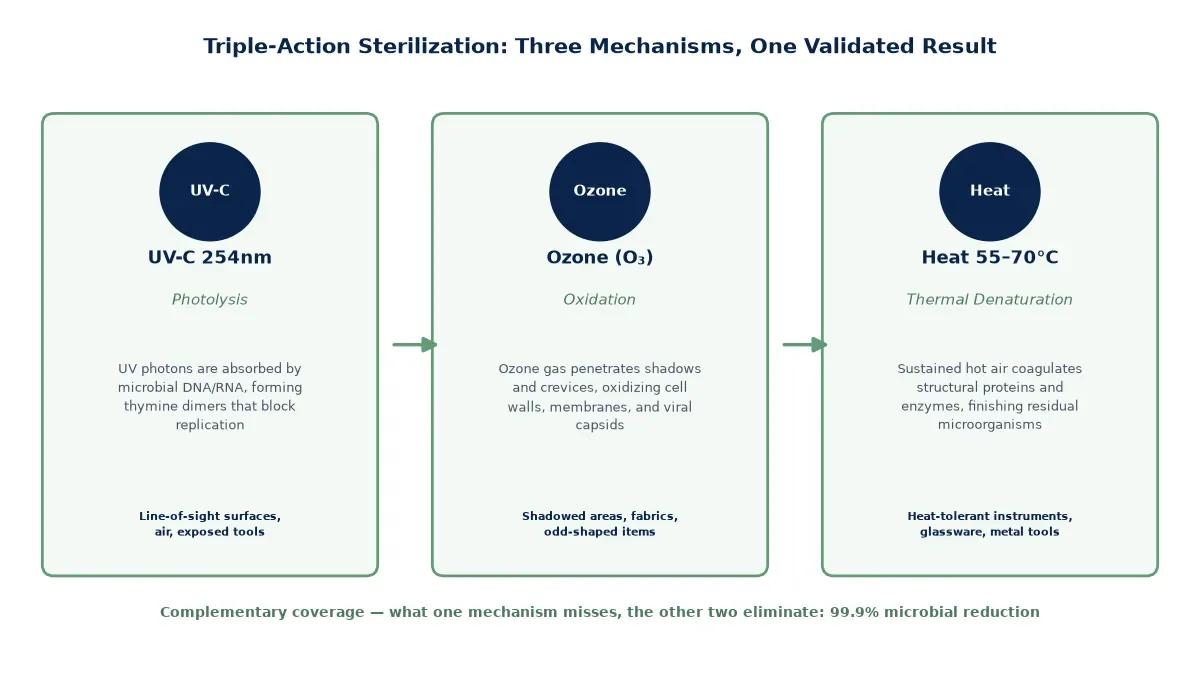
A triple-action cabinet does not simply “run three features.” Each mechanism attacks microorganisms through a physically distinct pathway, and each has a coverage profile the other two lack.
UV-C at 254nm: Photochemical DNA Damage
The cabinet’s germicidal lamps emit ultraviolet light at 254 nanometers — the output line of low-pressure mercury discharge lamps, sitting within 4% of the 265nm peak of microbial DNA absorbance. When a bacterium, virus, or mold spore absorbs enough UV-C photons, adjacent thymine bases in its DNA fuse into thymine dimers. The genetic code becomes unreadable: the organism cannot replicate, and a microorganism that cannot replicate is, for practical infection-control purposes, dead.
UV-C is fast and leaves no residue, but it works strictly line-of-sight. A shadow cast by a rack, a handle, or a textured surface blocks the photons completely. (For a deeper look at lamp physics and dosing, see our companion article on how UV-C germicidal lamps work.)
Ozone (O₃): Gas-Phase Oxidation That Reaches the Shadows
Ozone solves the shadow problem. Generated inside the sealed chamber — either by a dedicated ozone lamp emitting 185nm vacuum-UV or by a small corona module — ozone is a gas, so it flows everywhere air flows: behind instrument hinges, into fabric weaves, around odd-shaped items, and inside crevices no lamp can see.
As one of the strongest industrial oxidants, ozone attacks microbial cell walls, membrane lipids, and viral protein capsids on contact, rupturing the structure and inactivating the organism. When the cycle ends, ozone spontaneously decomposes back to ordinary oxygen (O₂) — accelerated by the cabinet’s heating phase — so items come out residue-free.
Heat at 55–70°C: Thermal Protein Denaturation
The third mechanism is sustained warm air. Holding the chamber at 55–70°C coagulates the structural proteins and enzymes that every microorganism depends on, while simultaneously drying the load — a critical secondary benefit, because dry storage denies surviving microbes the moisture they need to recover. The heat phase also accelerates ozone decomposition, clearing the chamber for safe door-opening.
Why Three Mechanisms Achieve What One Cannot
Single-technology cabinets each carry a known blind spot:
| Mechanism alone | Strength | Blind spot |
|---|---|---|
| UV-C only | Fast, residue-free surface kill | Shadows, crevices, fabrics |
| Ozone only | Full volumetric penetration | Slower on thick organic load; needs sealed chamber |
| Heat only | Reliable, doubles as drying | Heat-sensitive items excluded; longer cycles |
Combined in one programmed cycle, the three mechanisms overlap their coverage maps. UV-C handles exposed surfaces in minutes; ozone sweeps the geometry UV cannot reach; heat finishes heat-tolerant items, dries the load, and purges residual ozone. The result is a validated 99.9% (3-log) microbial reduction across bacteria, viruses, and fungi — including hard-to-kill spores — regardless of how awkwardly the items are shaped or stacked.
There is also a redundancy argument. In regulated environments, process failure is not an option. If a lamp ages or an item shadows a corner, the other two mechanisms still carry the cycle. Triple-action design is, in effect, built-in process insurance.
Where UV + Ozone + Heat Cabinets Are Used
Medical and dental practices — Instruments, trays, mouth mirrors, and reusable tools between patients. The sealed, residue-free cycle suits clinics that cannot run a full autoclave for every load, and the drying phase keeps instruments storage-ready. Larger wardrobe-style models (300–910L) handle textiles, masks, and shared equipment.
Laboratories — Glassware, sampling tools, and small apparatus that must be both sterile and chemically uncontaminated. No rinse water means no reintroduced impurities.
Beauty, salon, and wellness — Combs, scissors, towels, and manicure tools turned over many times per day. Fast auto modes keep pace with client flow, and the absence of chemical odor matters in a client-facing space.
Hospitality and food service — Tableware, cups, and kitchen smallwares. Hot-air drying leaves items cupboard-ready, and ozone deodorizes as it disinfects.
Home use — Baby bottles, pacifiers, toothbrushes, phone, keys, and masks. Compact 38–80L cabinets bring clinical-grade hygiene to a countertop.
Industrial and OEM integration — Document archives, electronics servicing, optical components, and cleanroom-adjacent workflows where liquid disinfectants would damage the load.
Choosing the Right Cabinet: A Practical Checklist
- Capacity first. Count your busiest hour, not your average day. 38–80L covers countertop and clinic loads; 268–400L suits commercial turnover; 800L+ wardrobe models serve laundries and hospitality.
- Chamber material. Stainless steel interiors reflect UV-C (boosting effective dose) and resist ozone corrosion far better than painted steel.
- Programmed auto modes. A good controller sequences UV + ozone + heat automatically and locks out unsafe door-opening — no operator judgment required.
- Ozone management. Confirm the cycle ends with an ozone-removal phase. For sensitive indoor environments, cabinets can also integrate catalytic ozone removal filters in the exhaust path.
- Touch-screen controls and timers. Repeatability is the point of a validated process; presets remove human variance.
Featured Model: ZTP80-K8 Multi-Purpose Disinfection Cabinet
A practical reference point for everything above is our ZTP80-K8 80L UV Ozone Disinfection Cabinet. It packages the full triple-action cycle — 254nm UV-C irradiation, sealed-chamber ozone fumigation, and hot-air circulation with automatic modes — behind a touch-screen interface in an 80-liter stainless chamber: large enough for a clinic day-load or a salon’s tool turnover, compact enough for a treatment room counter. Auto programs handle sequencing and cool-down, so operators press one button and collect a dry, sterile, ozone-free load.
For OEM and volume buyers, the same triple-action platform scales across our cabinet range from 38L countertop units to 910L double-door wardrobes. Browse the full disinfection cabinet series or contact our engineering team for a configuration matched to your workflow.